

From kindness genes to stress-busting hormones, doctors Sarah and Louise explain why being kind matters and how it can even help your menopause.
In this blog, Health in Menopause specialist, Dr Sarah Ball, has teamed up with Dr Louise Oliver, a GP, Functional Breathing Practitioner & Therapeutic Life Coach. After reading Dr David Hamilton’s book, ‘The joy of actually giving a F**K’, both Sarah and Louise were fascinated by the science behind kindness and the impact it has on the body and mind.
As Louise explains:
“Sarah and I frequently hear patients talking or thinking about themselves in an unkind manner, often with little knowledge about the negative consequences it will have on their body. Perhaps you feel cross and angry with yourself when a healthy eating plan has gone by the wayside or you keep putting things off, or you’ve totally lost it and shouted at someone you love.
It’s time to raise the profile of being kind – in particular being kind to yourself – during the perimenopause and beyond. As doctors, we both see health and wellbeing like many pieces of a jigsaw puzzle. Being kind to yourself and others is an important piece of that puzzle, just like sleeping well, eating healthily and staying active are other pieces.
So we wholeheartedly recommend reading or listening to David’s book, but in the meantime, we’re excited to share some of his points that really hit home for us.”
Love, empathy, compassion and kindness are innate in all of us – they are human values. Unfortunately today, especially online, society can be divided into ‘them’ and ‘us’. But as David puts it:
“There doesn’t need to be a them or us. Let there be we.”
“Kindness is the small acts that say, ‘I see you, and you matter.”
Kindness is baked into our DNA
Kindness as a force or quality is complex and often influenced by a combination of environmental factors, personal experiences and conscious choices.
Through evolution, we have developed kindness genes that predispose us to more compassionate and cooperative behaviour when the right mix of these other factors are present.
If you’re interested in a deeper dive on these genes, they are:
- OXTR (Oxytocin Receptor Gene) – empathy, generosity, reading others’ emotions
- AVPR1A (Vasopressin Receptor Gene) – altruism, social bonding, charitable giving
- SLC6A4 (Serotonin Transporter Gene) – higher resilience to stress promoting a more positive outlook and more stable mood
- DRD4 (Dopamine Receptor D4) – engagement with socially beneficial acts if rewarded for doing so
- COMT (Catechol-O-Methyltransferase) – decision making, emotional control, can increase capacity for patience and kindness in challenging situations
- MAOA (Monoamine Oxidase A) – mood regulation, impulsive aggression.
The science behind kindness
David brilliantly explains the science behind kindness and nicknames it a “happy smoothie – Nature’s reward for being awesome.”
When we experience kindness the brain releases dopamine, serotonin, oxytocin and natural opiates such as endorphins – producing that lovely warm, satisfying feeling.
David explains how oxytocin can be viewed as a ‘kindness hormone’ and kindness is the true opposite of stress. In fact, the only hormone more powerful than the stress hormone cortisol is oxytocin.
As well as when we give or receive kindness, we also release oxytocin when breastfeeding, having an orgasm, are bonding socially, when we touch others or a pet, and when we express empathy.
Practicing kindness and compassion builds up the happiness and empathy regions in the brain. One study in the book describes how kindness changes the activity of certain immune system genes, even leading to anti-aging effects!
How kindness helps your menopause
When we are kind, oxytocin helps release nitric oxide and atrial natriuretic peptide (ANP) helping to relax and expand our blood vessels. This helps lower blood pressure and gives that nice, warm feeling in your chest. It also reduces the workload on our heart and helps reduce the risk of heart problems in the future.
Free radicals and inflammation increase in our body when we experience stress. Stress can be a result of being unkind to yourself, feeling angry, or generally living out of sync with how we have been biologically designed to live (such as eating lots of processed foods).
Amazingly, oxytocin has been shown to act as an antioxidant (neutralises free radicals) and is anti-inflammatory (neutralises inflammation). When the anti-inflammatory hormone estrogen reduces around menopause, being kind to yourself (and others) is one option to add to your menopause toolbox to offset the loss of estrogen.
The ripple effect
David beautifully describes how kindness creates ripples…
By being kind to someone and how you made that person feel, they’ll probably be kind to five people over the course of the next day or so.
Those five people will probably be kinder to five more people each
and then those 25 people will also probably be kinder to five more people each.
Approximately 125 people benefiting from a single kind thing that you did!
In Louise’s local supermarket, this ripple effect seems to have developed with a common practice of letting those with less items jump the queue, which has led to lots of smiling and conversations between strangers.
The balance between being kind to yourself and others
David describes a sweet spot to aim for by using a baking analogy. Being kind to others is like adding all the ingredients that make a cake taste amazing but treating yourself kindly is like giving the cake a chance to bake properly. Neglecting the baking time element can lead to you feeling burned out or under appreciated.
 When being kind feels impossible
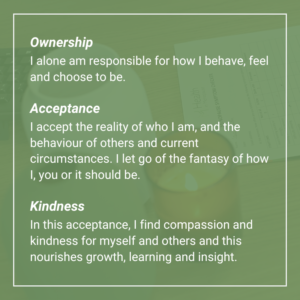
Louise recently had an interesting conversation with Rachel Anderson, executive coach at Time for Tea & Empathy. She notices in her work that the unhappiest, most stuck, most stressed out clients are full of blame and shame, are exhausted by their own frustrations, and are burdened by impossible expectations they put on themselves.
Rachel uses the acronym OAK to help describe the phases (similar to a tree’s life cycle) that you can focus on to help move towards kindness.
Kindfulness meditation
If you are struggling to be kind to yourself, take a moment to gently close your mouth, breathing in and out of your nose, slowly and gently (if you are able to do this) and as David suggests in his book, mentally recite a few times:
‘May I be happy and well and safe. And may I feel at ease.’
You could do this in a supermarket queue, on the bus, whilst filling a glass of water….
Being kind to yourself can help you thrive. Consider reading David’s book, share this blog, create your own ripples and join us as kindness crusaders!
Last updated: May 2026
