
Blood tests are not usually needed to diagnose perimenopause or menopause. These stages of life are most often recognised based on your symptoms and changes in periods. Testing may be considered in certain circumstances — for example, if premature ovarian insufficiency (menopause before age 40) is suspected, or if your healthcare professional feels the results would help guide your treatment.
When it comes to hormone replacement therapy (HRT), three main female hormones are relevant: estradiol, progesterone (or progestogens) and testosterone. However, only one of these is routinely monitored with blood tests:
- Progesterone / progestogens are prescribed to protect the lining of the womb when estrogen is used. The dose is tailored according to individual response in terms of bleeding. Blood tests are not required.
- Testosterone may be added to HRT, usually to help with symptoms such as low libido. A blood test is generally recommended before starting treatment. This is not to make the diagnosis, rather it is checked to ensure that adding testosterone to your HRT treatment will not lead to Testosterone levels that are above the normal range for women. This is monitored with annual blood testing.
- Estradiol is the main form of estrogen used in HRT. Current guidelines do not recommend routine blood testing for estradiol, and this booklet will explain why.
What is Estradiol?
Estradiol is one of the main types of estrogen. Estrogens are a group of sex hormones that have many important roles in the body, especially for women’s health. They support:
- Reproductive health
- Bone and heart health
- Mood and mental wellbeing
- Skin and hair quality
- Many other body functions
The different types of estrogen
There are several types of estrogen in the body, and each plays a different role:
- Estrone (E1) – the main estrogen after menopause. It has weak activity and is made mostly in the adrenal glands and fat tissue.
- Estradiol (E2) – the strongest form of estrogen, produced in the ovaries before menopause. This is the main estrogen used in HRT and some vaginal estrogen products.
- Estriol (E3) – the least potent estrogen, circulating levels are barely detectable. It is found in certain “low dose” vaginal treatments, where it can help with vaginal dryness and urinary symptoms.
- Estetrol (E4) – produced by the foetus and is only detectable during pregnancy.
Because there are several types of estrogen, measuring just estradiol in the blood does not show the full picture of estrogen activity — particularly after menopause, when estrone becomes more dominant.
Why does estrogen have so many effects in the body?
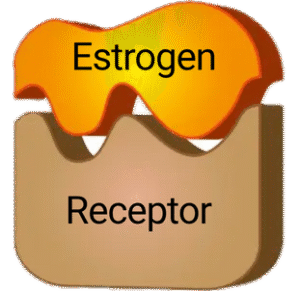
Think of estrogen as a key and special sites in the body (called receptors) as locks. When the right estrogen “key” fits into the right “lock,” a process is switched on — like opening a door.
For example, when estrogen attaches to its receptors in the bones, it helps rebuild and strengthen them. Receptors are found all over the body, which is why estrogen affects so many areas: from the brain and mood to the heart, skin, and beyond.
Research shows that after menopause; there are changes in how many receptors are present and how sensitive they are.
For example:
- In the brain, receptor density can increase, helping the brain adapt to lower hormone levels — but this change may also be linked to symptoms like low mood or brain fog.
- In bones and reproductive tissues, receptor numbers may drop, reducing estrogen’ s effect in these areas.
This helps explain why the symptoms and health effects of menopause vary so much from one woman to another. Genetics, lifestyle, and diet also play a role.
Some women need only small amounts of estrogen to feel well, while others need more. There is no single “ideal” level that works for everyone.
What happens to estrogen during perimenopause and menopause?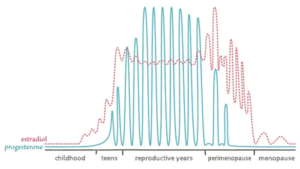
- Perimenopause: Hormone levels swing up and down unpredictably. A single blood test only captures one moment in time and may not reflect the full pattern of change.
- Menopause: Estradiol levels drop overall, but estrone levels remain relatively higher. Because estrone is not routinely measured, an estradiol test alone cannot show your full estrogen activity.
Is there a “normal” estradiol level?
Not really. Estradiol levels change dramatically both between different women and within the same woman across a single menstrual cycle. Studies show “normal” levels can range anywhere between 5 and 3,500 pmol/L — a huge variation.
HRT cannot mimic the natural fluctuations of estradiol before menopause, and there is no agreed target level to reach in perimenopause or post menopause. Instead, treatment is tailored to your symptoms and needs.
Why are estradiol blood tests not reliable?
Several factors make blood levels an unreliable guide:
- How you take HRT
- Skin preparations (patches, gels, sprays) are absorbed differently depending on things like skin type, activity, temperature, and hydration.
- Tablets are mostly converted into estrone in the liver, so blood levels do not reflect the amount of active estrogen available.
- Diet, alcohol, smoking, exercise, and stress can all change absorption from day to day.
- Timing
- Hormone levels rise and fall at different times after a dose. A test taken two hours after applying gel could look very different from one taken 12 hours later.
- Some people process hormones quickly, others slowly.
- Laboratory differences
- Different labs use different machines, which can give different results even from the same blood sample.
- Home testing kits are especially unreliable.
Because of these issues, two blood tests taken on the same dose can give very different results, even in the same person.
Do estradiol levels reflect how I feel?
Not always. Some women feel well on lower doses, others on higher ones. Blood levels do not reliably predict symptom control or wellbeing.
What about bone and heart health?
There is no single estradiol level that guarantees bone or heart protection. Evidence shows:
- HRT helps maintain bone strength even at low doses.
- For heart health, the benefits of HRT depend more on when you start (ideally before age 60 or within 10 years of menopause) rather than your blood level.
What about women with premature ovarian insufficiency?
Blood tests can be useful here, but estradiol is not routinely recommended in diagnosis due to expected fluctuations:
- Diagnosis usually relies on checking another hormone (FSH).
- Estradiol may sometimes be measured if symptoms aren’t improving, bone protection is inadequate, or side-effects occur.
So, what’s the best guide for treatment?
Your symptoms and wellbeing are the most important indicators. We will listen to your experience and adjust your treatment flexibly. Blood testing may occasionally be used if symptoms persist and poor absorption is suspected, but it is not needed for routine monitoring.
Last updated: June 2026
