
Go from strength to strength by including resistance training in your daily activities
If you’re a woman aged between 40 and 60 and interested in staying healthy and active, there’s a high chance your social media feeds have surfaced Jennifer Anniston’s at-home workout programme, Pvolve.
The promises made on this website tap in to exactly what we know to be healthy goals for us at this stage of life: increased strength and lean muscle mass, staying mobile and flexible with reduced pain and injury, and improving our metabolism and body composition.
Promising ‘strong, healthy and able’ bodies is an extremely attractive offer to midlife women, precisely because so many of us do not feel this way about our bodies – perhaps ever – but especially now due to menopausal changes that can leave us feeling sluggish, achy and out of shape.
If you want to go back to basics for an overview of staying active and healthy during peri/menopause, take a look at our resource titled Keep Moving.
Why strengthening is important
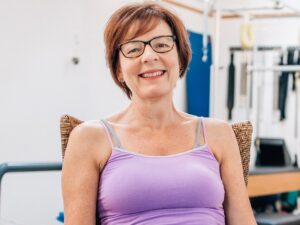
The principles behind resistance training workouts to strengthen our joints and improve muscle strength and bone health are sound. Dinah Siman is a Pilates teacher focussed on helping menopausal women. She explains why these strengthening and moving against resistance elements are a crucial part of her practice:
“If, like me, you have experienced a lot of injuries or pain during your peri- to post menopause transition, you may be worried about hurting yourself if you try weights or other forms of resistance training.
Pilates is a body conditioning method designed to focus on movements which maintain and increase muscle mass, improve your bone health, balance, co-ordination and body awareness. Working with weights, body weight and resistance bands in my Pilates practice enables me to focus on strength, as well as endurance, for my musculoskeletal system and it gets the blood pumping too.
With a Pilates teacher, you’ll learn correct body alignment and movement technique to enable you to start adding resistance safely – whether it’s weights, bands or your body weight. I often view the stretchy bands as supportive scaffolding in addition to the added resistance they give. They actually increase my body awareness and I genuinely feel stronger and more awake in my muscles when I use them. Remember you need to enjoy the movements to keep doing them. I also love the mindful, focused and calm approach Pilates offers.”
Ideas to strengthen
You may enjoy regular exercise like walking or swimming but realise that, as much as you enjoy it and it provides a full body aerobic workout, it doesn’t quite hit the spot for strengthening and movement with resistance. Dinah suggests some simple ideas to work on strengthening, in addition to your weekly exercise routines:
“One of the best ways to use a stretchy band or loop is to tie it around your thighs whilst sitting, standing or lying down (knees bent) and press out sideways with your legs and hold it for a few seconds. It’s a really easy movement to make a habit at your desk or in the mornings. You will strengthen your butt muscles, which are part of your core group, and support your back, hips, knees and feet – and we all want that strength and stability as we age.
Another great movement is the ‘sit to stand’ – it’s just what it says on the tin. Keeping a long spine and bending at the hips, sit and stand without holding on to anything, 10 times. Pause just above your chair and, if you still have the stretchy band on your legs, add in an outward press into the band.
The wall sit is another perfect leg strengthener. You literally lean your back against the wall, (upper back and pelvis making contact with the wall) and then gently bend at the hips and knees, holding the position for as long as is comfortable. It’s often used as an exercise before a skiing trip, but it’s perfect for leg strengthening and will up the heart rate too.”
Being strong and fit before, during and after menopause, isn’t only about your hardcore strengthening work at the gym or running a 10km in under an hour. We also want to wave the flag for slower-paced more gentle movement based activities that can bring many benefits to our physical and mental health too.
Doing a daily stretch routine, a gentle yoga practice, T’ai Chi, or breathing and relaxation exercises can help improve balance, flexibility, reduce aches and pains and physical responses to stress, and enhance feelings of calm and contentment. And who doesn’t want some of that during menopause?!
You can find out more about Dinah at www.menopausepilates.com and follow her on Instagram at @menopausepilates.
Her book is available to buy now and includes a chapter from our very own Dr Sarah Ball! You can find it here.
Last updated: May 2026
